·News
A New NFT Contract for Artists
Yayoi Shionoiri and Ryan Su propose a new contract that keeps copyright in the hands of artists
Yayoi Shionoiri and Ryan Su
Yayoi Shionoiri and Ryan Su propose a new contract that keeps copyright in the hands of artists
Yayoi Shionoiri is an art lawyer who supports artists. She serves as Executive Director to the Estate of Chris Burden and the Studio of Nancy Rubins, responsible for stewarding Burden’s art historical legacy and promoting Rubins’s artistic practice. She is also U.S. Alliance Partner to City Lights Law, a Japanese law firm that represents creators, innovators, and artists; an Outside Board Director to Startbahn, an art x blockchain company that seeks to bring greater reliability to art world transactions in the art ecosystem; and Legal Advisor to KLKTN, a startup focused on engendering community among performers and their supporters through NFTs. Shoinoiri has previously served as General Counsel to Artsy, Associate General Counsel of the Guggenheim Museum, and Legal Advisor to Takashi Murakami. She has degrees from Harvard University, Cornell Law School, and Columbia University. She serves as a Board Director to the Asia Art Archive in America, and an Advisory Panelist at the Serpentine Gallery’s Legal Lab.
Ryan Su is an art lawyer who holds LLB and LLM degrees. He is Special Counsel, Art & Intellectual Property Law at OC Queen Street, the Singapore office of Osborne Clarke. He is a member of the firm’s International Blockchain Working Group and speaks frequently on intellectual property, NFTs, and the metaverse. Su also advises artists, galleries, collectors, and museums on how to safeguard their interests. He is the recipient of the Patron of the Arts and Patron of Heritage awards for his contributions to the arts in Singapore and is currently completing a PhD in dispute resolution in the art world.
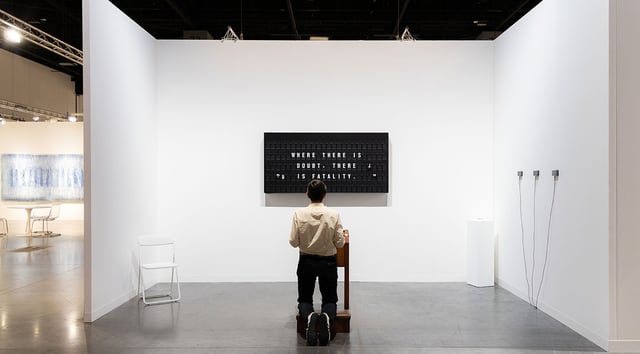
Jonas Lund, “MVP (Most Valuable Painting),” commissioned by Aorist, runs April 4 to 17, 2022 at W1 Curates, London.
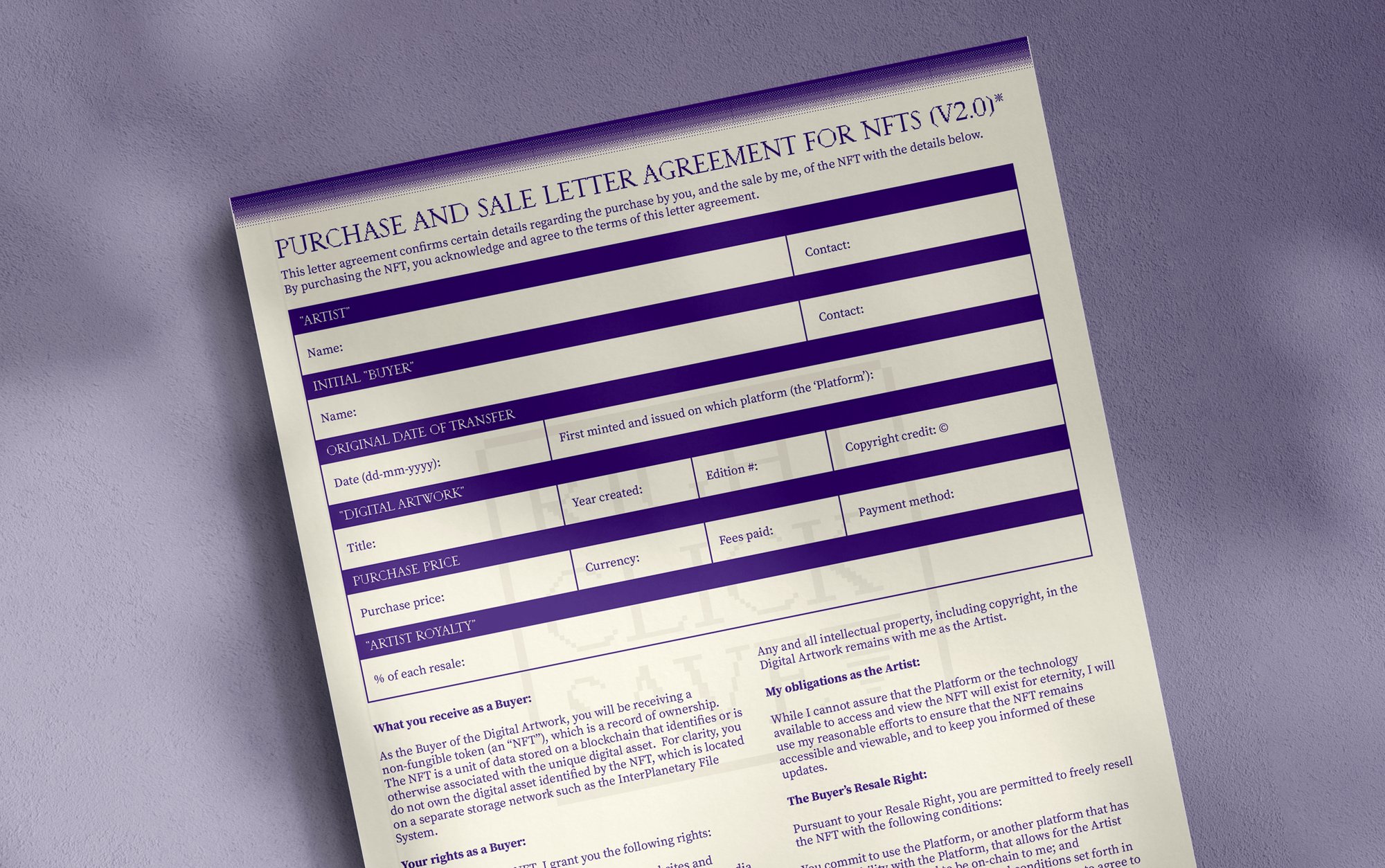
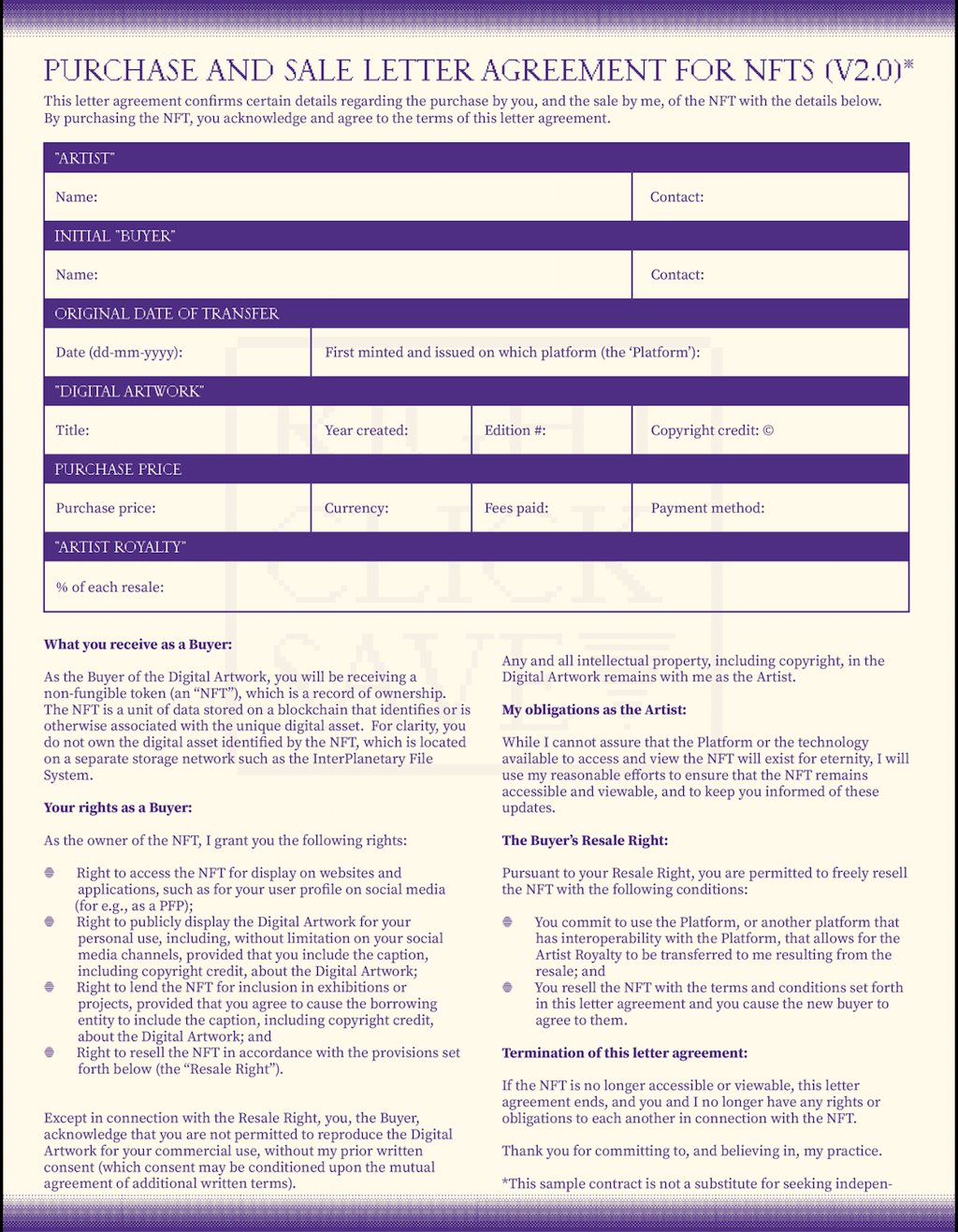
During the pandemic summer of 2021, we worked across time and geography between New York and Singapore to draft a simple “Purchase and Sale Letter Agreement for NFTs” to add an additional voice in the developing conversation about visual art NFTs. It was our hope to provide a contract with simple, easy to understand language that helps to provide additional security to artists who mint and issue NFTs, and also gives enough flexibility to be adapted to a variety of circumstances. We undertook this thought experiment because code-based “smart contracts” — while innovative in their attempt to automate process — are not yet as smart as they need to be.
The proposed set of terms, whose most recent iteration we present here, contains details of the artwork, the percentage royalty received by the artist upon each resale, and the obligations and rights of both artist and buyer. Notably, the copyright in the actual artwork does not transfer to the buyer but is retained by the artist, as is standard with physical artworks in the art world. We envision our proposed set of terms to exist “off-chain” (i.e., in writing) either listed on the website describing an NFT project, or living on the InterPlanetary File System (IPFS), together with the digital assets underlying the NFT. In the future, we hope to find secure ways to include these terms in a way that does not subject the data (or the assets underlying the NFT) to off-chain vulnerabilities.
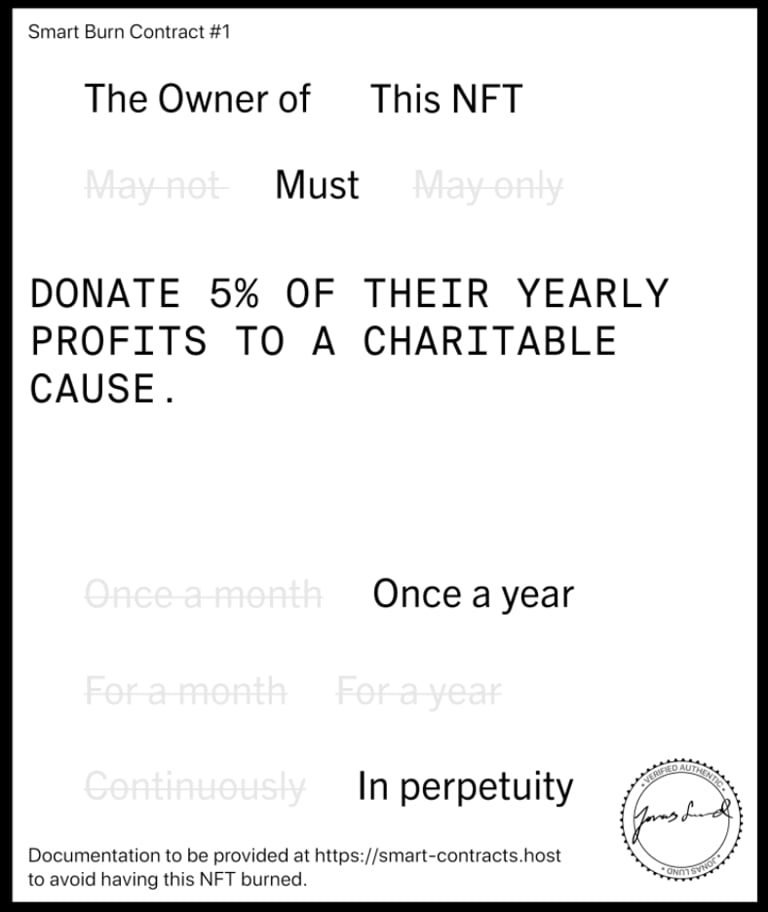
Since we published our proposed set of terms last September, we have received and incorporated feedback from our community, further clarifying what a collector receives when they purchase an NFT (including the possibility of using the NFT as a collector’s PFP). Jurists and artists interested in the application of copyright to visual art NFTs generally saw value in having a standard form of contract with concepts already familiar to them.
That said, an increasing number of NFT projects now afford commercial use rights by an NFT purchaser — a developing model that is still unique to the NFT art community, and definitely not “standard” for the art world. To reflect the NFT community’s own standards, we have allowed for the possibility of a collector to negotiate with an artist for commercial use rights, maintaining the importance of dialog between both parties.
Traditional art world stakeholders have also joined in buying and selling visual art NFTs in droves. In doing so, they have started to set forth their own terms and conditions for the purchase and sale of NFTs, a problem further elaborated here.
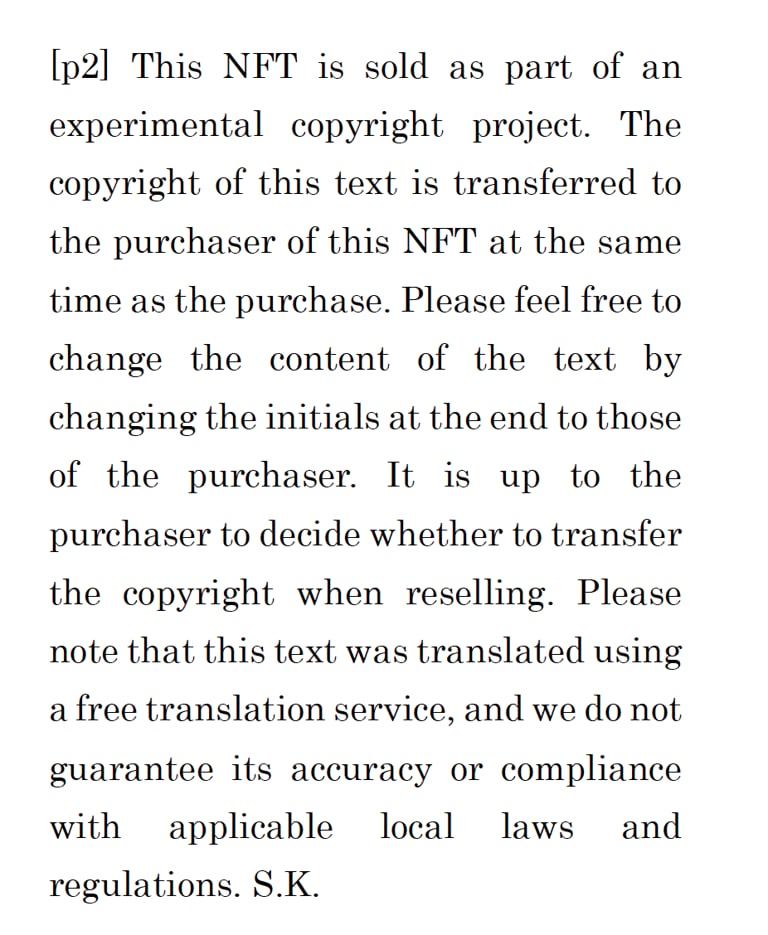
The field is also quickly developing, with a number of NFT lawsuits currently being filed with the courts. This year, in the first NFT case reported in Singapore, a magazine publisher is suing an NFT production agency over the sale of NFTs created with elephant motifs from the Jim Thompson fashion brand. The NFT production agency had allegedly breached its duty of care and was negligent in offering the NFTs for sale on the Binance NFT marketplace for only an hour, after which the unsold NFTs would be “burned.” The magazine publisher alleged it had not been informed that the sale would only last an hour, or that the unsold NFTs would be “burned” (when they were represented as “Sold Out”).
The sale was disappointing, with only 3,431 of the 60,600 total NFTs selling. Yet 20 percent of the sales proceeds had to be set aside, allegedly for “market-making” activities which included subsequently buying and selling the NFTs. As parties still had to meet these and certain other costs despite the poor performance, litigation followed. While the issues here are wider than our proposed agreement between artist and buyer, the case reflects the present unregulated reality where, in the absence of a contract with a clear delineation of rights, there remains tremendous uncertainty.
Suffice it to say that, as the legal structures, rules, and guidelines relating to NFTs continue to develop, we encourage conversation between legal and creative communities in order to ensure greater transparency in, and access to, this ever-evolving field.
No comments yet. Be the first to share your thoughts.
Mentioned in this article
People: Jonas Lund, Ryan Su, Yayoi Shionoiri|